Guide
Seasonal Maintenance Checklist for Built-In Appliances
A four-season checklist for premium built-ins on the Sound Shore, written around what the weather here actually does to them.
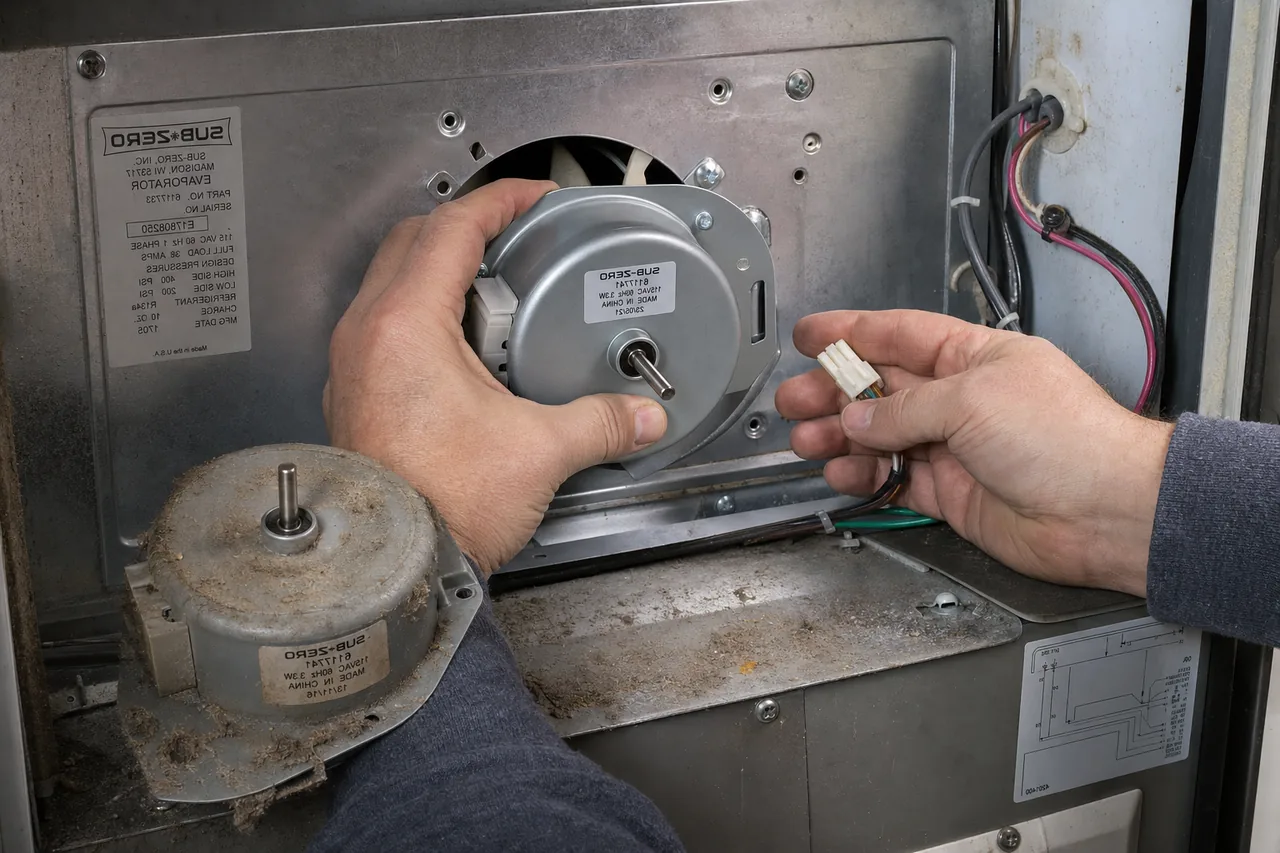
Most maintenance lists are written for nowhere in particular. This one is written for a village a few hundred yards from Long Island Sound, where salt air, summer humidity and autumn storms each do something specific to a kitchen full of built-ins.
Do the items in the season they are listed under. That ordering is the point.
Spring — undo the winter
Condensers, properly. The heating season leaves the most dust of the year on refrigeration coils. Pull the grille, vacuum the fins with a brush attachment, and look at the fan while you are in there.
Door gaskets. Winter is hard on rubber. Wipe every gasket with warm soapy water, dry it, and run the dollar-bill test around the whole perimeter of each door. A gasket that has gone stiff in three places will not recover, and replacing it now is $150 to $450 rather than a summer of a system that never catches up.
Water filters. Six-month intervals are the general rule. Spring and autumn is an easy schedule to actually keep.
Ice maker, after the quiet season. Households use less ice from November to March, and a machine that has been sitting produces cloudy, hollow, slow-forming cubes when it starts up again. Run and discard the first two or three batches before assuming a fault.
Summer — the hard season for cold
Ambient heat is the load that finds every weakness.
Give refrigeration room to breathe. Kitchen temperatures in July make a marginal condenser a failing one. This is when a dirty coil that survived all winter finally stops the unit.
Wine cabinets need watching now. Many are built to a narrower climate class than a refrigerator. Put an independent thermometer in the cabinet for a few days in August and compare it against the display. Summer is when a sensor that has drifted becomes visible.
Humidity and glass doors. Condensation inside a glass-fronted wine cabinet in July is usually humidity plus a tired gasket rather than a refrigeration fault. Check the seal before panicking.
Run the hood. Summer cooking plus summer humidity is the combination that puts moisture into cabinet fronts. The hood is doing more work in August than you think.
Autumn — before the kitchen gets busy
This is the maintenance season that pays for itself, because everything in the list below is a failure you do not want in late November.
Ovens. Calibrate before baking season rather than during it. An oven that runs 25°F low will not announce itself until something does not rise.
Range burners. Look at every flame. Blue and even across the ring is right. Yellow tipping means ports or air shutters want attention, and it is a fault you can fix at leisure now or at speed on a holiday.
Hood filters and damper. Pull the baffles, clean the channels, and check the backdraft damper moves freely. A damper that has seized open is where the January draught over your range comes from.
Dishwasher filters. Lift the lower basket, unscrew the sump filters, clear them. Autumn is also the right time to clean the inlet screen at the tap end of the fill hose.
Condensers again. Second of the two annual cleanings — or the second of four if you are within a few blocks of the water, where quarterly is the honest interval.
Winter — protect the electronics
Surge protection. Storm-season voltage on the shoreline is not gentle and premium built-ins are electronics-first. A control board is $400 to $850; whole-house surge protection costs less and prevents the whole category.
After an outage, check before you trust. Power back on does not mean everything restarted correctly. Walk the kitchen: refrigerator temperatures, ice maker cycling, oven clock, dishwasher accepting a program.
Unheated spaces. A refrigerator or wine cabinet in a garage or an unheated pantry can stop working in cold weather, because the thermostat reads a cold ambient and never calls for cooling — so the freezer thaws while the room is freezing. It is not a fault, but it will spoil food just as effectively.
Watch for salt on stainless. Winter shoreline wind carries it inland. Wipe exterior stainless with the grain and dry it; corrosion that starts at a seam is far easier to prevent than to remove.
The quarterly item, wherever you live in the village
Clean the condenser. If you take nothing else from this page, take that. Near the Sound it is the single maintenance action with the largest effect on how long your refrigeration lasts, and it is the one most often skipped because the coil is behind a grille nobody has opened.
What to leave to a technician
Sealed systems, gas connections, anything behind a panel that is held by more than clips, and any fault that returns after you have corrected the obvious cause. The diagnostic is $95, credited toward the repair, with a 1-year parts and labor warranty on the work.
Call (914) 809-9382 to book seasonal service in Larchmont, or book online at any hour.