Guide
Sub-Zero Not Cooling: A Troubleshooting Guide
Why a Sub-Zero can lose the fresh-food side while the freezer stays perfect, what to check first, and the point at which it becomes a sealed-system job.
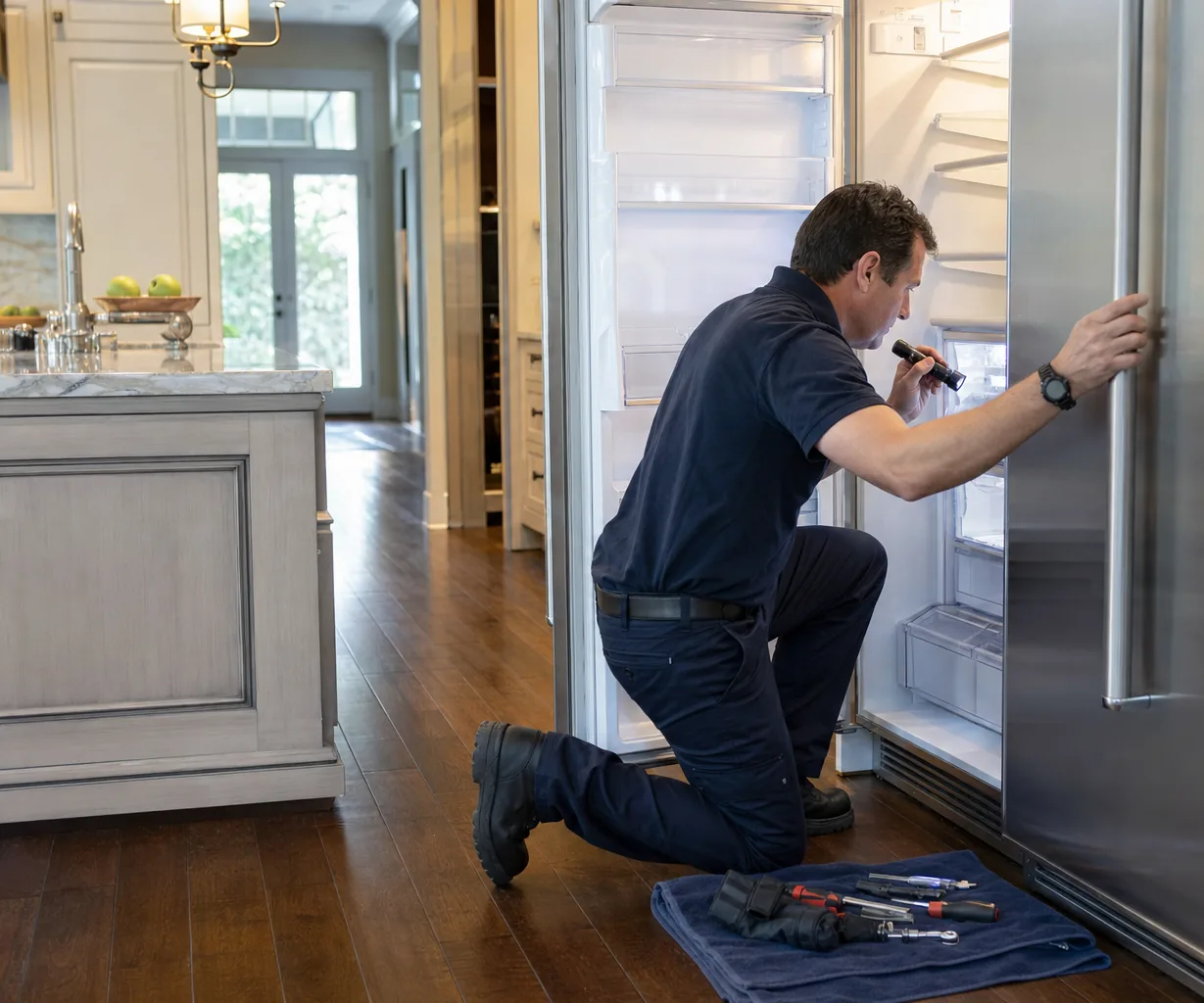
Start by asking which side is warm
This is the question that splits a Sub-Zero diagnosis in half, and it is the one most people skip.
Sub-Zero’s dual refrigeration means the fresh-food compartment and the freezer run on separate sealed systems with their own compressors and evaporators. That is why a Sub-Zero can sit at 52°F in the refrigerator with ice cream rock solid six inches below. On a conventional single-compressor refrigerator that symptom means a dying evaporator fan or a stuck damper. On a Sub-Zero it usually means one entire system is down while the other is untouched.
So before anything: put a glass of water with a thermometer in each compartment, wait an hour, and write down two numbers. Target is 38°F fresh food, 0°F freezer.
The checks that are genuinely worth doing yourself
1. Look at the condenser. On most built-in Sub-Zeros the condenser sits behind the upper grille. Pull the grille and look. If it is a grey mat rather than visible fins, that is your answer more often than not — the unit cannot reject heat, runs continuously, and slowly loses the battle. Vacuum it with a brush attachment, gently, with the power off.
Near the Sound this matters more than the manual suggests. Salt-laden air makes dust cling, and coils in the waterfront blocks of Larchmont Manor and out on Premium Point load up noticeably faster than the same unit a mile inland.
2. Check the door seals. Close the door on a dollar bill and pull. If it slides out with no drag, the gasket has lost its grip at that point. Work around the whole perimeter. A gasket that has hardened — normal after ten or twelve years — lets humid air in continuously, and the system never gets ahead of it.
3. Confirm airflow inside. A compartment packed to the back wall blocks the return vents. Give it two inches of clearance at the rear.
4. Listen. With the kitchen quiet you should hear a compressor running and air moving. Silence in a warm compartment, or a fan that clicks and stalls, is a real finding worth reporting when you call.
What the symptom pattern tells a technician
| What you see | What it usually points at |
|---|---|
| Fresh food warm, freezer perfect | The fresh-food system: evaporator fan, defrost, or that sealed system |
| Both compartments slowly warming | Condenser, airflow, door seals, or a shared control fault |
| Freezer frosting heavily, fridge warm | Defrost circuit — heater, terminator or board |
| Running constantly, temperatures nearly right | Dirty condenser or a failing gasket; catch it now |
| Ice maker stopped, temperatures fine | Water supply, inlet valve or the ice maker module — not cooling at all |
That last row deserves its own note. An ice maker that stopped is very often a separate and much cheaper problem than a refrigerator that stopped. The two get reported together and they are usually not the same fault.
Where the homeowner checks end
Anything involving the sealed system — refrigerant, compressor, evaporator — is not a do-it-yourself repair, and it is not a parts-cannon repair either. It needs gauges, it needs the system opened under controlled conditions, and getting it wrong converts a repairable unit into scrap.
The honest tell is this: if the condenser is clean, the seals grip, the air is moving, and a compartment still will not hold temperature, the next step is instrumentation, not another part.
Is a twenty-year-old Sub-Zero worth repairing?
Usually yes, and that is not a sales line so much as a reflection of how these are built. We regularly service units installed in the late nineties that have years left in them. The calculation changes when the repair is sealed-system work on a unit whose cabinet is also going, and we will say so plainly rather than quote it.
Sealed-system and compressor work on premium built-in refrigeration runs roughly $800 to $2,200 all in. Common faults — fans, gaskets, defrost components, control boards — land between $300 and $750. The $95 diagnostic is credited toward the repair, and everything carries a 1-year parts and labor warranty.
Buy yourself time while you wait
Move anything genuinely perishable into the freezer side if that side is healthy, keep the doors shut, and do not crank the control colder. On a system that is already struggling, colder settings change nothing and can make frosting worse.
Call (914) 809-9382 with your two temperature readings in hand. It is a five-second piece of information and it shapes what the technician brings on the truck.