Guide
Wolf Range Burner Not Lighting: Causes and Fixes
One burner clicking without catching, every burner clicking, or a burner that lights and drops out — three different faults on a Wolf range, and what each one means.
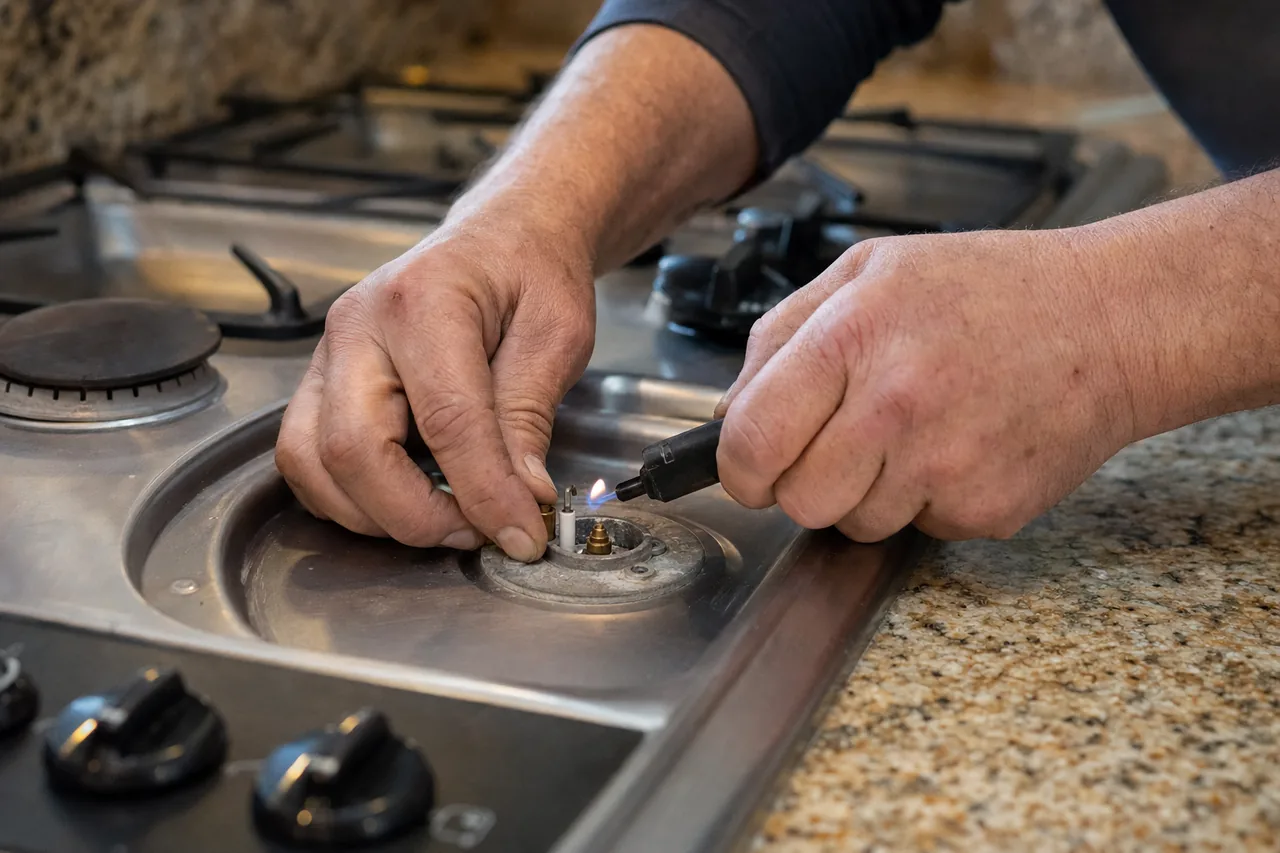
Three different Wolf complaints get reported with the same sentence. Separating them takes about thirty seconds and it decides everything that follows.
- One burner clicks but will not light.
- Every burner clicks, none light.
- A burner lights, then drops out seconds later.
Work out which one you have before reading further.
Case 1 — one burner, clicking, no flame
Almost always local to that burner, and often recoverable without a technician.
The cap is off. Wolf’s sealed dual-stack burners have a cap that seats in one orientation only. After a cleaning it is easy to set it down rotated, or not quite flat. A cap that is a few degrees out puts the ports away from the electrode, and you get a perfect spark into empty air. Lift it, look at how the notches line up, seat it flat.
The ports are fouled. A boil-over that dried in place blocks the ports nearest the igniter. Cold burner, stiff brush, and a straightened paperclip through anything still glazed. Never a drill bit — enlarging a port changes the flame permanently.
The burner is wet. Water sitting in the well under a freshly cleaned cap suppresses ignition. Lift the cap, dry the well, leave it uncovered for an hour.
If the cap is seated, the ports are clear, the well is dry and it still will not catch, the electrode is likely cracked and shorting into the burner body instead of arcing across the gap. That is a part, not a cleaning.
Case 2 — everything clicks, nothing lights
When all burners spark and none light, stop looking at burners. You have a gas supply problem.
Check in this order. Is the range’s own shutoff valve still open? Did anything else on the same supply also stop — a water heater, a boiler? Was gas work done in the building recently? If the meter was closed and reopened, air in the line can take longer to purge than you would expect, and the range is simply the fixture that shows it first.
If a neighbouring appliance is out too, the problem is upstream of your kitchen entirely.
If you smell gas at any point, stop. Leave the house and call the utility from outside. Nothing in this guide is worth staying in the room for.
Case 3 — lights, then drops out
The most specific symptom on the list, and the most diagnostic.
A Wolf burner that lights and then goes out within a few seconds is usually a flame-sensing or grounding fault. The control fires the igniter, the burner lights, and the system then fails to confirm the flame — so it closes the gas valve again. A cracked electrode, a corroded ground at the burner, or a loose connection behind the manifold will all produce exactly this.
Worth understanding: the safety is working correctly. The range is doing what it should when it cannot see a flame. Bypassing it is not an option.
There is one non-fault version. On a very low simmer a burner can be blown out by a draught, and Larchmont kitchens with a window open toward the Sound in autumn produce this reliably. If it only happens at the lowest setting, with a window open, and never otherwise — close the window and test again.
The ignition system, in one paragraph
A spark module energises an electrode beside each burner. Gas flows when the valve opens. The spark crosses a small gap to the grounded burner body and lights the gas. The system then has to confirm the flame or it shuts the valve. Every failure above is one of those four stages breaking: no gas, no spark, a spark landing in the wrong place, or a flame that cannot be confirmed.
What we see most in this kitchen stock
Cracked spark electrodes lead by a distance, then fouled ports, then ground connections that have corroded — the last of those noticeably more common in the shoreline blocks, where salt air works its way behind the panels over a decade.
Range and oven repairs on premium equipment generally run $250 to $900 including parts and labour. The diagnostic is $95, credited toward the repair, with a 1-year parts and labor warranty on the work.
One thing worth doing anyway
While the burner is apart, look at the flame on the ones that do work. A correct Wolf flame is blue, even around the ring, with no yellow tipping. Yellow means the ports or the air shutter want attention, and catching it now buys you a year of warning before it strands you mid-dinner.
Call (914) 809-9382 and say which of the three cases you have. It changes what goes on the truck.